Choose an approach · Extract fields
Which model should extract your fields?
Start with a cheap, fast model and test it on a few rows. Move to a bigger one only if fields come out wrong, then check the same rows again.
The options
| A cheap, fast model | A larger model | |
|---|---|---|
| Good for | Facts stated plainly: names, dates, case numbers | Facts you have to work out: who the parties are when it's unclear, what a document decided |
| Cost | Lowest | Higher; the estimate shows how much |
| Watch for | Missing a fact phrased unusually | Still check: a larger model can be wrong too |
Check what a mismatch means
| Source | Answer key | Gemini 3.5 Flash-Lite |
|---|---|---|
| RV-CV-2026-00804 · plaintiff | Mei Chen and proposed library patron class | Mei Chen |
The filing names Mei Chen individually and on behalf of a proposed class. The key includes the class; the model kept only her name. Decide which you want, and say so in the field's description.
If you want to extract from PDFs directly rather than their text, only OpenAI and Anthropic models that read PDFs will work.
Settings
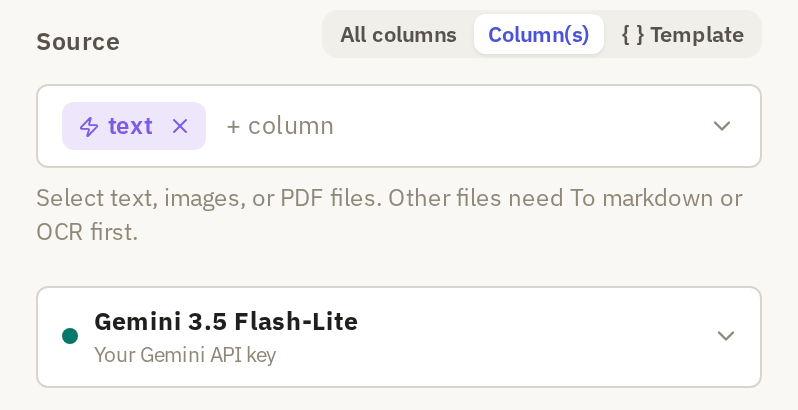
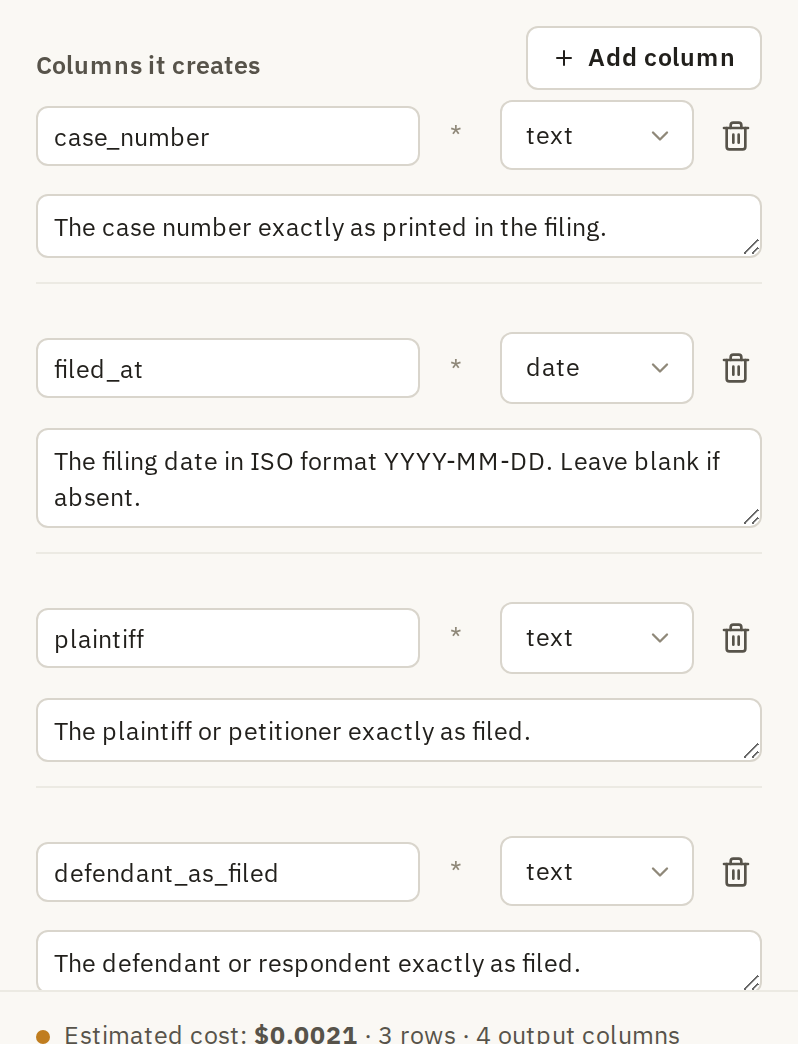
The model matters less than how you describe the fields. In Extract fields, click the engine box to choose a model. Then, under Columns it creates, give each field a name, a type and a description.
Write each description as an instruction to someone who's never seen the documents. "The filing date in YYYY-MM-DD format. Leave blank if absent." gets better results from any model than "date".
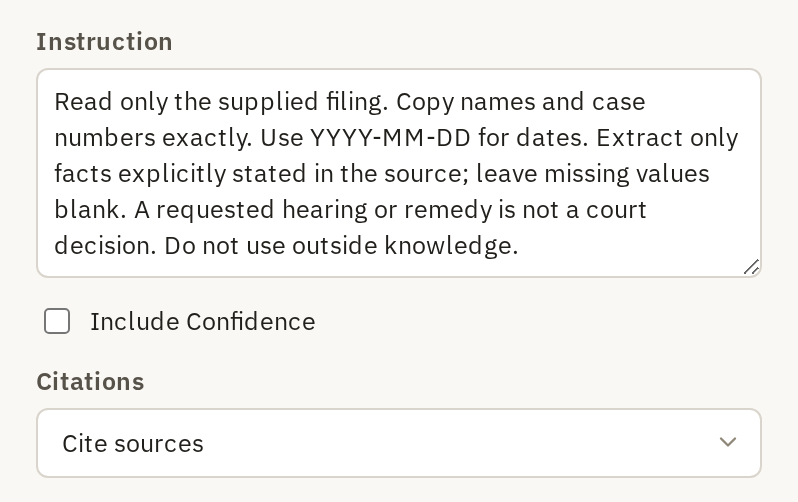
Use Instruction for rules that apply to every field, such as "Copy names exactly" or "Use only what the document says". Keep Cite sources on under Citations, the default, so you can check each value against its passage.
To compare two models fairly, keep the fields and instruction the same and run both on the same few rows. Compare does this side by side.
Where to start
| If… | Do this |
|---|---|
| You haven't tried anything yet | Pick a cheap model, preview three rows, read the results. |
| A field is wrong on several rows | Rewrite its description first. Then try a larger model on the same rows. |
| The model fills in a fact that isn't in the document | Tell it to leave the field blank when the document doesn't say. A larger model won't fix missing evidence. |
| The field always follows a pattern, like a case number | Try Extract text with regex: no model, no cost, no guessing. |